Articles for Laundromat Owners, Laundry Room Managers, HR Professionals, Recruiters, Sales People, Job Seekers.
Sounds like an odd mix of subjects right? Ev has had solid careers in all these areas. His brand is "A Heck of A Nice Guy," so he wants to pass on knowledge to others.
Published with a touch of humor from someone in the trenches.
Small chassis washers like the Maytag MHN33 or similar size washers are not made to last as long as their large chassis washer cousins. All small chassis washers no matter who makes them are not meant to take the place of a large chassis washer.
Since all of these little machines are not bolted down to a concrete or steel base they are subject to vibrations and movement that their large chassis cousins don't have to worry about.
As a result wires and hoses can vibrate and break loose from their anchors inside the machine where you don't usually think or see to check.
In the case of this washer it kept giving errors that seemed common and might work for a cycle or two and then return. The owner cleared the error on the computer board each time and even replaced the computer board and the errors still returned on a regular basis.
Opening up the top of the washer and tucked towards the lower rear of the washer it was discovered that the wire harness had broken loose from the wire tie that held it on the back of the frame and was rubbing on the concrete ballast until the insulation had rubbed away and the ballast started rubbing on the wires and a few wires had no insulation and would short on each other and caused the errors.
If you ever have to open up any panels on your washers and dryers to make a repair, take a look at the wires and belts that you can see just to make sure you're not missing something that might become an issue later on.
Rowe changers were long a staple in laundromats, laundry rooms, car washes, arcades, and any other place that needed to shell out quarters to the public. The Rowe BC1200 (front loading) and the Rowe BC1400 are all over the place. Many years ago American Changer bought Rowe and discontinued any production and support of these changers soon afterwards. If you have one of these changers you might have wondered where do you go to get parts or service. For a long time there were ton of independent repair shops or owners that had stocks of parts and repair knowledge. Over the last several years those parts stocks have dried up and the techs that worked on these changers retired or moved onto different companies so now unless you have experience working on these machines yourself you might be stuck with a bum changer if you have problems.
Different manufacturers make a conversion kit that you can change out the guts of these Rowe changers if you are in a situation where you can't remove the cabinet from the wall and need something to work in the space that you already have there. One of the best of the independent factory authorized service providers for Rowe changers in my opinion is/was Changetec in Grand Rapids, Michigan. The techs there have been very helpful over the years (Daryl is a legend when it comes to his knowledge). Changetec found a hole in the market as other changer manufacturers created conversion kits for the BC1400 (rear loading version) but not the BC1200 (front loading version) and they have developed their own conversion kit that is less in price than other equipment manufacturers. If you have a changer that has the bill acceptor and change cup in the order like the above picture then this conversion kit might be a great option. It is simple to install and operate and at the time I purchased the kit was about $1,000 less than any other option I could find.
Watch the video below to see if this is an option for your Rowe changers:
Rule #3 of owning a successful laundromat is "Keep it well lit." You want to have good lighting in your laundromat or laundry room for many reasons: -safety from crime and tripping hazards are two -advertising as customers can see inside how nice your facility is -customers can see how clean their clothes are
Advances in LED lighting have come a long way and the prices have dropped significantly and some utility companies have incentives for facilities to upgrade their lighting.
I went from incandescent to fluorescent bulbs and then about 10 years ago switched to LED bulbs and now have switched to flat full panel LED lighting and WOW!
I didn't realize how much of a difference the new lights would make in MY location!
I have large windows facing the west so I get lots of sun all day, however it was harder to see how much darker the back of the store was even with the sun out.
The lighting in the store is brighter and more even and I've gotten more compliments from customers about how clean the store is. I always thought the store was clean but now customers can see all the little nooks and so it is also a good time to remind your cleaning staff that they have to get all these little areas because they can now be seen!
A secondary benefit of the new lighting, but I think important, is how the new lighting made ME FEEL.
I've always liked spending time in my stores but I noticed a definite improvement in my enjoyment being in the store. The brightness lifted my mood and is reflected in my behavior at the store. Problems don't seem to be so bad and I think I leave the store more energized even after a long day of repairs.
If you think that everyone knows the benefits of good lighting,
here is a post and video from a laundry room that I had to go in to do a repair:
In an emergency you might need to stop a washer. Something gets stuck in the door as an example. Maybe you don't need to stop something. Perhaps you just need to spin something out. Here are some ways you can do either by clicking the link below:
Please keep in mind our fellow laundromat owners that were affected by the recent tornadoes in Menasha and Appleton
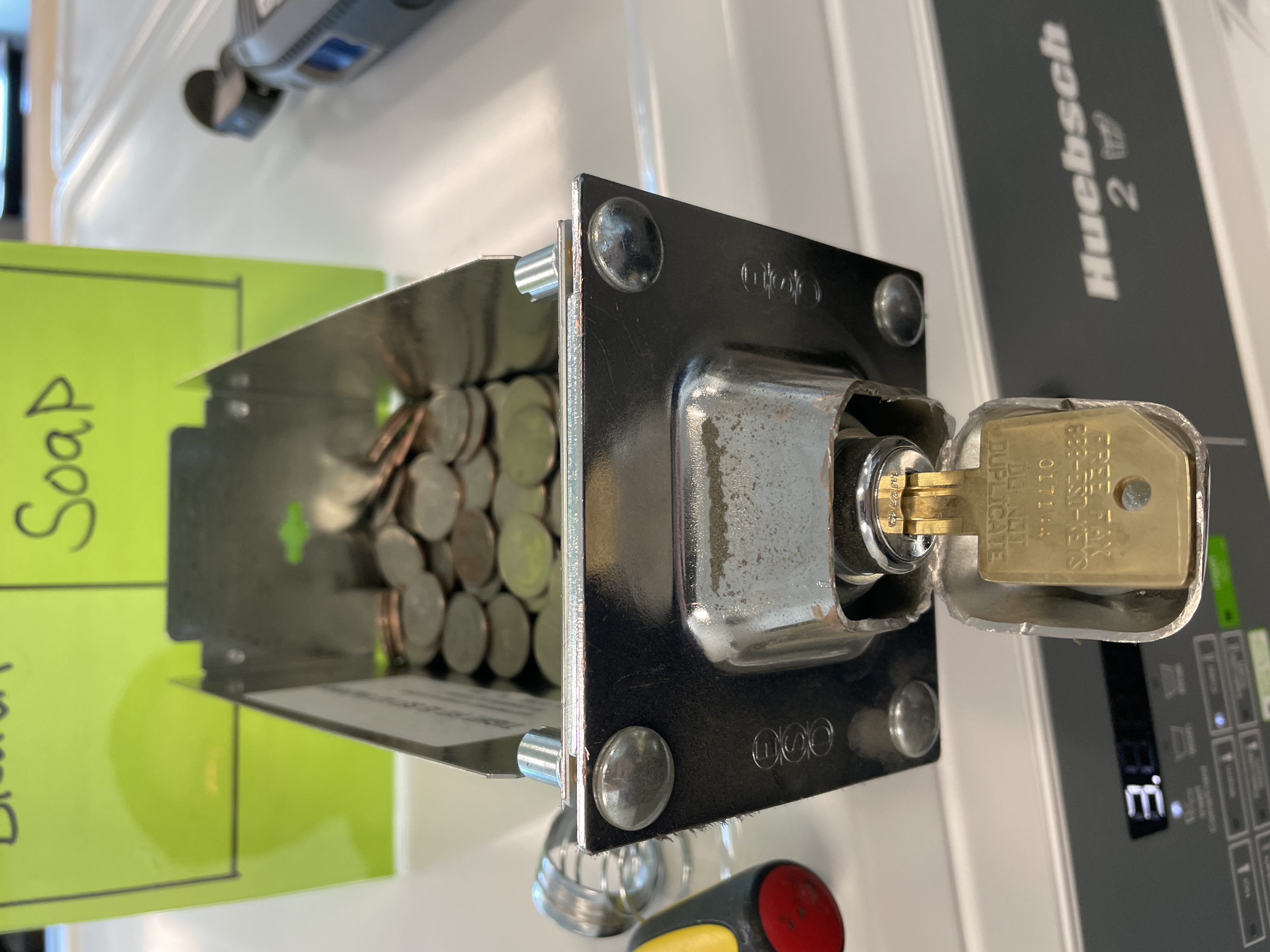
EVERET NEEDS YOUR ANSWERS to the Following Question: What do you say if a customer comments on money they see you pull out of a machine? Lets pretend they see a bucket of quarters and they say... "that sure is a lot of quarters/money!" You respond how?
I've responded in many ways. Two of which are: "Maybe it is a lot of quarters but you should see the utility bills!
"Unfortunately I have to pay bills in dollars and not quarters so divide this amount by four and it isn't a lot of money."
I'd like to publish answers in a future blog post so if you want to share your response call, text, or email me.
Let me know if it is okay to use your first name/initials or if you want to remain anonymous.
-Everet
Q3 REBATES from HUEBSCH
The rebates apply to qualifying Huebsch equipment purchased and invoiced between July 1 and September 15, 2026.*
Hardmount Washer-Extractors
Model/Rebate
HCT020 $200 per unit
HCT030 $300 per unit
HCT040 $400 per unit
HCT060 $600 per unit
HCT080 $800 per unit
HCT100 $1,000 per unit
Tumblers
ProCapture™ Bonus: Additional $250 Rebate Per Tumbler
Model/Rebate
HTT30 $300 per unit
HTT55 $550 per unit
HT075 $200 per unit
HT075 w/ ProCapture™
$200 base + $250 ProCapture™ bonus
$450 per unit
New equipment only. Must be purchased through an authorized Huebsch distributor like EVERET from WASH
Tidbits From Everet's Answers
Below are articles from my laundry blog:
Make sure your security cameras cover windows and doors:
If you were at the open house you heard me say several of these jokes. People asked for them so here you go! If you have any others that you want to share please let me know!
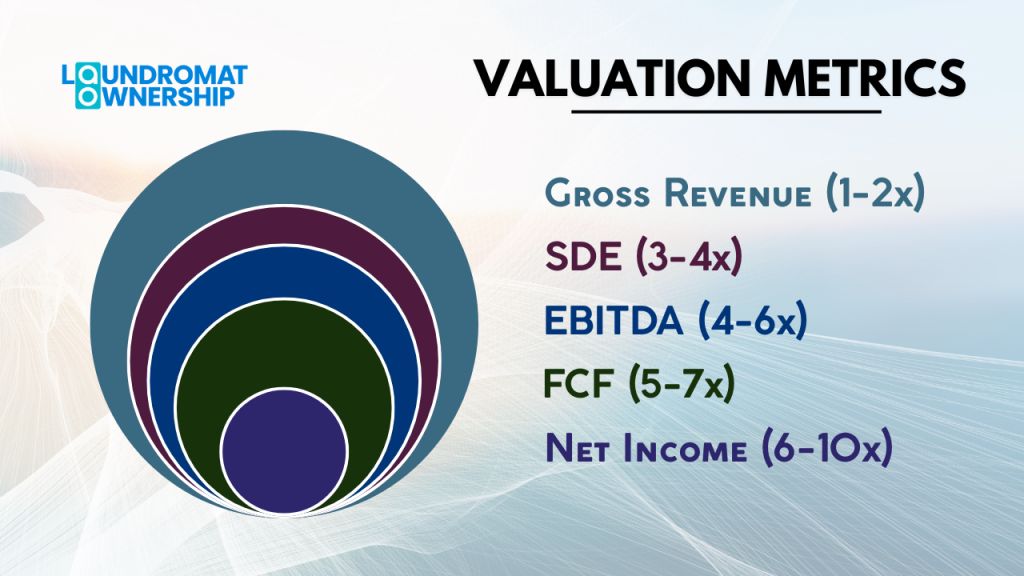
In this multi-part series, we’re exploring the most common metrics together and arm ourselves with the best possible understanding of how, when and why each part of the valuation is used.
Ian Gollahon13 Apr, 20268 min read
The article below was written by Ian Gollahon for Full Cycle Magazine, a publication of CLA. For those of you looking at selling a laundromat, or even buying one, here is an interesting read. Ev
As of July 22 he hasn't published part 2 so feel free to read the way I was trained on it over the years:
As of this date I've helped sell 19 laundries so I must know something of which I speak...Ev
How much is your laundromat worth?
For private and public businesses of all sizes, there is a whole language and tradition around the pricing of productive assets. Laundromats are typically a combination of hard assets and positive cash flow, so many business people, especially those who manage a variety of private or public equities, already have the tools on their toolbelt to arrive at a reasonable market valuation. In this multi-part series, we’re exploring the most common metrics together and arm ourselves with the best possible understanding of how, when and why each part of the valuation is used.
#1: The meaning of “Asset Sale”
An “asset sale” does not imply that only tangible assets are being sold.
Almost every sale of a laundromat is bought and sold in what is typically referred to as an “asset sale.” An “asset sale” is not necessarily what you are buying – but it is certainly how you are buying it. Laundromats are purchased in this way so that the new owner can start a fresh depreciation schedule and possibly take Section 179 expense elections. These GAAP standards and tax treatments dramatically reduce the amount of taxable income for the buyer. We’ll talk more about this under “Net Income.”
We can all agree that a laundromat with brand new machines is worth more than a laundromat with 20-year-old machines. Much like a 20-year-old car, outdated machines can sometimes be more expensive to keep operating and repairing than they are to replace. Because of this, the value of the assets, specifically the washers and dryers, often become a central talking point of the valuation for any laundromat.
There’s a good argument to be made for calculating the value of the assets as a discrete part of the purchase price – even if that number mostly exists in your head. It’s true that the buyer and/or the seller often conflate the machinery and the earnings into their valuation multiple, but they’re also both aware that the machinery is adding or subtracting some amount to the earnings multiple. For this reason, it’s best to get a good idea of how much life is left on the equipment and get a decent appraisal on what the machines are worth.
Balance Sheets are designed to track assets and their depreciation or Section 179 deductions. If a balance sheet is detailed and in proper order, it should show all the assets of a business (both tangible and intangible) along with depreciation taken and depreciable value remaining. Because of this, experienced investors might ask for a balance sheet when you’re trying to determine the value of your assets.
As a buyer, the “earnings multiple” that you buy from the seller will likely end up on your balance sheet as a variety of intangible assets like “Goodwill” or “Covenant Not To Compete.” Focusing too heavily on the names of these line items can be a trap. These intangible assets are just how businesses account for and then depreciate the entire purchase price of an asset sale. The “Trade Name” and “Non-compete” may be worthless to you, but it’s likely that your lawyer and your accountant will insist that you include them as line items on the purchase price. This is standard practice and could be helpful in the case of an audit or any future scrutiny of the purchase.
Summary: Laundromats are not just valued as the sum of their assets. They can be worth much more than the machinery or – in the case of a bad lease agreement – even much less than the value of the equipment inside the building. Whatever the case is for your laundromat, the value of the assets is a major consideration in finding the true market value.
In My Experience: The values assigned to the line items on the “Closing Statement” are important because this document becomes the basis for building the buyer’s balance sheet. There are real tax implications for the number assigned to every asset. Because of this, you’ll want to understand which line items are most beneficial to be higher or lower for your situation. For Example: “Goodwill” typically has a 15-year straight-line amortization requirement, but “Equipment & Machinery” can take a Section 179 Expense Election and apply to the first year of tax returns, so the value applied to these line items in your Closing Statement can dramatically increase or decrease the amount of Net Income you’ll need to claim and pay tax on. Instead of focusing on the name of each line item, it would be more strategic to understand the depreciation options for each line item.
#2: Leasing or Owning the Real Estate
Most laundromat owners do not own the building in which they operate. Instead, they are operating on a lease of the building from a landlord. This can be problematic since washers and dryers cannot easily be moved from one location to another. Depending on the age and value of the machinery, they may actually be worth less than the substantial cost to have them uninstalled at one location and reinstalled at a different location. This is part of what makes the lease so important to a laundromat transaction.
My new friend Dan Brinderson, owner of 10-store laundry chain Express Coin Laundry in California, looks for the following lease situation: “A five-year initial term with at least four options to extend for an additional five years, for a total of 25 years.” This agreement is particularly useful because it gives both parties the initial five years that they need to even make the commitment, but then it gives the laundromat owner an easy way out if after five years the location performs poorly. A 3% annual price increase with the option to reset in value after the first 10 years is a good way to protect both parties from major shifts in the market, but the reset part of this clause is typically only used for major market shifts.
Most landlords will require some sort of personal guarantee, which is a clause that makes the owner personally liable for the lease, but it’s important to dull the fangs on this biting clause with a limit on this liability. Brinderson shared that landlords are usually willing to compromise on this clause with a seven-month personal guarantee instead of writing the guarantee for all five years. When enacted, this limit to the personal guarantee gives the landlords seven months to find a new tenant, which is a reasonable amount of time for them to find another willing candidate. In case the location isn’t working out for the laundromat, this is much more reasonable than being personally responsible for five years of a losing location. Perhaps most importantly, it prevents the landlord from a “not my problem” sort of attitude if things go poorly for the laundromat.
Common Area Maintenance (CAM) is another lease issue that laundromat owners have to deal with, especially with professionally managed commercial properties. CAM fees can get unreasonably high, so it’s a good idea to put some sort of growth cap or limit on these, which provides an incentive for the landlord to keep these costs down. If the parking lot needs to be resurfaced in the near future, this may be especially important.
You can probably see that there is plenty of room for things to go wrong for both the landlord and the laundromat owner in these agreements, so having trust already established with the landlord can be an enormous advantage going into the conversation. In the case that the commercial property is available, I highly recommend buying it, especially since the SBA offers a special SBA 504 loan that gives subsidized interest rates and preferential terms for commercial real estate transactions.
Summary: Lease terms can be a deciding factor for the value of a laundromat, especially if the lease isn’t long enough. Try to get 25 years (in five-year terms) and a limit on the personal guarantee as well as the CAM fees. If the property is available for purchase, consider owning it.
In My Experience: In my view, if you can own the property that your laundromat is located on, then you will substantially decrease the existential risks of your business and substantially increase your security for the long-term investment that is a laundromat. When we purchased our chain of three laundromats, the seller owned two of the properties and although they were appraised and priced separately from the laundromats, we were still able to purchase the properties and fold them into our LLC that files as an S Corp. This reduces the administrative overhead of having a separate holding company and its tax advantaged for owner operated businesses that regularly have large amounts of Net Income.
Katsu Katsu Matsu My buddy A veterinarian friend I once had would always say..."everyone needs fur in their house." Pets do make our lives better and it is hard when they are loved to not see them well. Katsu (Japanese for "courage") crossed the rainbow bridge. He was my buddy is the simple and best way to put it. I've had many cats and they are all special. On Sundays he looked forward to F1 race days because he knew he could sit in my lap for several hours as I watched the race. If there was an Indycar race on after the F1 race that was a bonus time for him cuddling, sleeping, and purring. All of the black cats I've had have had different nicknames starting with "El gato." Katsu could always eat so he was "El Gato Hambre." You'll be missed buddy. Ev
first time in snow
his first vet visit at nine weeks
He liked to go under the blanket if he was sitting on your lap
A great lap cat
He loved to chase slot cars
Katsu is a big kitty! A great lap cat
yin and yang Chopsticks and Katsu
cats like to sit in boxes so we made an experiment if we made an outline of a box would the cat sit in it and he did...often
conquering Rapids International Raceway
Cuddling with his favorite soldier
him on last day
he would drink from cups
like most cats he loved bags and boxes
snuggling my boot
Just a silly pic with his sister
He had lots of cat stands but this old one that belonged to other cats we had was one of his favorites


.jpg)

.JPG)





.JPG)


