Being a recruiter has many parallels to being a salesperson. In fact I'd argue that it is one of the toughest sales positions because you have to convince the candidate they are right for the job and get them motivated, then you have to convince the employer that they are the right candidate. There are two sales made each time.
I recently did a workshop for a number of recruiters who were getting stalled by gatekeepers, blown off by decision makers, and stumped by how to prospect for new companies to reach. These recruiters weren't your "traditional salespeople," however their role demanded they know selling skills. One of the things we talked about was establishing a relationship with the people they were selling to. Once again, the day I do that seminar Dave Kurlan, author of Baseline Selling, has a timely blog post. It is printed below. Instead of salespeople, insert the word recruiters and you see it is the same thing.
Thanks!
Ev
"A Heck of A Nice Guy"
Many people have written extensively on the topic of relationships and selling. One common topic is that people only buy from people they like and the other is how to develop strong relationships. There is nothing wrong with either of those topics but they surely miss the mark in two important areas.
1.Some people develop wonderful relationships but the relationships take much too long to develop.
2.How many times have you or one of your salespeople had a strong relationship only to discover it was still not enough to get the business?
People do have to like you but it's not enough. Liking and trusting you has some value, but not enough to compensate for a price or quality gap. The added value must come from understanding their compelling reasons for buying what you sell and for spending money, sometimes more money, to do business with you rather than your competitor. When you have conversations that lead to and uncover their personal, compelling reasons, you'll be seen as a trusted adviser, different from all the rest, and THEN they'll see the value in doing business with you.
Unfortunately, in order to ask those questions and have those discussions, a relationship must be established. And this is where the double edged sword comes into play. The discussion I'm talking about is a first meeting discussion. But the relationship that requires is often a 2nd or 3rd meeting relationship. So the problem I present is, how does one develop a late-stage relationship in an early stage meeting?
This is what the elite salespeople (top 6%) do so well. It's what the mediocre (bottom 74%) do so poorly. And it's what all of your salespeople must be able to do effectively and consistently in order to win more than they lose.
How do your salespeople stack up?
Wednesday, October 20, 2010
Monday, October 18, 2010
How to Deal with Recruiter and Sales Personalities
Dave Kurlan, author of Baseline Selling, is one of the formost sales thinkers in the country.
He wrote a blog about the different personalities that sales people have and how to deal with them as a manager. I think these personalities apply not only to salespeople, but to recruiters as well. What do you think?
Thanks!
Ev
Here is Dave's blog:
My regular readers know that when it comes to evaluating the sales force or assessing sales candidates, I have no use for personality assessments. If you're a first time or new reader, look no further than here for documentation and proof. Regulars also know that I sometimes reprint emails received from sales candidates who have been offended by a potential employer's request to take an assessment. Many of these uninformed, unprepared, emotional candidates refer to the assessment as a personality test - the assessment it least resembles. There are personalities in sales, but the various traits do not predict performance and there isn't a personality trait that translates into sales because the traits are discovered in social contexts, not business or selling contexts. That said, there are diverse individuals that you will have to manage and they aren't really personalities as much as they are characteristics. You might call them one or two word descriptions of people instead of characterizing them as personalities. Following are 9 Sales Characters and how you can manage them more effectively.
PETE THE PERFECTIONIST - Pete won't begin anything until he is sure he can do it perfectly. Symptoms are procrastination, failure to implement your suggestions and ferocious rewriting of his notes (because the first set wasn't perfect). Your job, should you decide to accept it, is to provide Pete with permission to fail. Assign a goal that you both know he can achieve. Tell him to get some "no's" and it's not only OK to bring back some "no's" but you would prefer it to a "think it over" or a "maybe". Read more
NICK THE KNOW IT ALL - Nick is easy to spot because he drives you nuts. He knows everything, as evidenced by his willingness to say, "I know!" You can't tell him anything new and he will always defend the way in which he has always done things. His lack of flexibility and resistance to change is his downfall. Your job, and in this case, it's too much fun to call it a job, is to challenge or dare Nick. Tell him what needs to be accomplished, but tell him you don't think he can do it. Tell him you'll have to get someone else to do it. Enough said.
ORSON THE OVER ACHIEVER - Orson is always busy, always striving to break the record, out-earn his latest paycheck, set the new company record for most miles driven in one day, etc. While you may have the urge to take some of the burden off Orson's shoulders, he actually functions best when over burdened so leave him completely alone. He doesn't need to be managed with a heavy hand. Just tell him what you expect and he'll get it done. It never occurred to him that he could find a way not to do it! Read More
LOIS THE LOYALIST - Lois is like a puppy dog, always following you around, sucking up to you, learning from you and even idolizing you. In fact, she'd love to have your job if it meant you would be getting a better one! The only thing you have to do with Lois is tell her what to say, who to say it to, when to say it, what will happen then and what to do after that. Make sure she has it down exactly and then have all the confidence in the world that your own personal groupie will get the job done exactly as you would have done yourself.
CONTENT CARL - Carl has sales know how but isn't using it as aggressively as he once did. His sales are probably flat and his calls for new business are dropping every year. He has a good existing customer base and services it well but you still want him to be more than a $100,000+ service man. Have a very serious, extremely strong meeting with Carl, in which you tell him how terribly unhappy you are with his performance. Tell him exactly what you expect from him, by when, and what will happen if he doesn't perform. Read More
NEED FOR APPROVAL ALICE - More than anything, Alice needs for you to like her. Her need for approval will cost you both a fortune in lost business in the field but you can play her like a fiddle in the office. Just tell her you are losing respect for her. Tell her she isn't measuring up to the others in the office. Tell her that she is disappointing you. She'll do whatever it takes to get back in your good graces. Read More
UNSTABLE URSULA - Ursula needs to get her head on straight, might come from a dysfunctional family and is used to being yelled at. In fact, it's the only thing to which she seems to respond. Ask her nicely to do something and she blows it off. Lose your cool with her and it's done in a New York minute.
MIKE THE MAVERICK - Mike plays by his own rules, is difficult to manage, won't take direction and drives you nuts. The only reason he still works for you is that he outperforms everyone else on the sales force including you! Managing Mike is easy. Tell him you respect his need for independence and his desire to do it his way. Tell him to stay away from the office as much as he likes, avoiding sales meetings and keeping away from the other salespeople. You'll continue to let him write his own rules as long as he continues to out-produce everyone else. If his production ever drops below a certain level, then he will have to follow the same rules as everyone else.
MISERABLE MARVIN - Marvin complains a lot. He has more excuses than hooky playing high school renegades. His performance is always below acceptable levels and despite that, everyone thinks he has potential - except that he's never approached it. Marvin is the easiest of the bunch. Create an exit plan that fires him for non-performance and a lousy attitude.
He wrote a blog about the different personalities that sales people have and how to deal with them as a manager. I think these personalities apply not only to salespeople, but to recruiters as well. What do you think?
Thanks!
Ev
Here is Dave's blog:
My regular readers know that when it comes to evaluating the sales force or assessing sales candidates, I have no use for personality assessments. If you're a first time or new reader, look no further than here for documentation and proof. Regulars also know that I sometimes reprint emails received from sales candidates who have been offended by a potential employer's request to take an assessment. Many of these uninformed, unprepared, emotional candidates refer to the assessment as a personality test - the assessment it least resembles. There are personalities in sales, but the various traits do not predict performance and there isn't a personality trait that translates into sales because the traits are discovered in social contexts, not business or selling contexts. That said, there are diverse individuals that you will have to manage and they aren't really personalities as much as they are characteristics. You might call them one or two word descriptions of people instead of characterizing them as personalities. Following are 9 Sales Characters and how you can manage them more effectively.
PETE THE PERFECTIONIST - Pete won't begin anything until he is sure he can do it perfectly. Symptoms are procrastination, failure to implement your suggestions and ferocious rewriting of his notes (because the first set wasn't perfect). Your job, should you decide to accept it, is to provide Pete with permission to fail. Assign a goal that you both know he can achieve. Tell him to get some "no's" and it's not only OK to bring back some "no's" but you would prefer it to a "think it over" or a "maybe". Read more
NICK THE KNOW IT ALL - Nick is easy to spot because he drives you nuts. He knows everything, as evidenced by his willingness to say, "I know!" You can't tell him anything new and he will always defend the way in which he has always done things. His lack of flexibility and resistance to change is his downfall. Your job, and in this case, it's too much fun to call it a job, is to challenge or dare Nick. Tell him what needs to be accomplished, but tell him you don't think he can do it. Tell him you'll have to get someone else to do it. Enough said.
ORSON THE OVER ACHIEVER - Orson is always busy, always striving to break the record, out-earn his latest paycheck, set the new company record for most miles driven in one day, etc. While you may have the urge to take some of the burden off Orson's shoulders, he actually functions best when over burdened so leave him completely alone. He doesn't need to be managed with a heavy hand. Just tell him what you expect and he'll get it done. It never occurred to him that he could find a way not to do it! Read More
LOIS THE LOYALIST - Lois is like a puppy dog, always following you around, sucking up to you, learning from you and even idolizing you. In fact, she'd love to have your job if it meant you would be getting a better one! The only thing you have to do with Lois is tell her what to say, who to say it to, when to say it, what will happen then and what to do after that. Make sure she has it down exactly and then have all the confidence in the world that your own personal groupie will get the job done exactly as you would have done yourself.
CONTENT CARL - Carl has sales know how but isn't using it as aggressively as he once did. His sales are probably flat and his calls for new business are dropping every year. He has a good existing customer base and services it well but you still want him to be more than a $100,000+ service man. Have a very serious, extremely strong meeting with Carl, in which you tell him how terribly unhappy you are with his performance. Tell him exactly what you expect from him, by when, and what will happen if he doesn't perform. Read More
NEED FOR APPROVAL ALICE - More than anything, Alice needs for you to like her. Her need for approval will cost you both a fortune in lost business in the field but you can play her like a fiddle in the office. Just tell her you are losing respect for her. Tell her she isn't measuring up to the others in the office. Tell her that she is disappointing you. She'll do whatever it takes to get back in your good graces. Read More
UNSTABLE URSULA - Ursula needs to get her head on straight, might come from a dysfunctional family and is used to being yelled at. In fact, it's the only thing to which she seems to respond. Ask her nicely to do something and she blows it off. Lose your cool with her and it's done in a New York minute.
MIKE THE MAVERICK - Mike plays by his own rules, is difficult to manage, won't take direction and drives you nuts. The only reason he still works for you is that he outperforms everyone else on the sales force including you! Managing Mike is easy. Tell him you respect his need for independence and his desire to do it his way. Tell him to stay away from the office as much as he likes, avoiding sales meetings and keeping away from the other salespeople. You'll continue to let him write his own rules as long as he continues to out-produce everyone else. If his production ever drops below a certain level, then he will have to follow the same rules as everyone else.
MISERABLE MARVIN - Marvin complains a lot. He has more excuses than hooky playing high school renegades. His performance is always below acceptable levels and despite that, everyone thinks he has potential - except that he's never approached it. Marvin is the easiest of the bunch. Create an exit plan that fires him for non-performance and a lousy attitude.


Wednesday, October 13, 2010
Biggest Mistake Salespeople Make #2
Here is another common mistake salespeople make.
I used to do this one as well. My comments are below, however here is best selling author Dave Kurlan's take:
When attempting to close sales most salespeople have a tendency to use either a good/better/best, option A/option B, or price 1/price 2 method of proposing and/or presenting. Everyone likes options, right? Yes, people love options. The only problem is that options prevent most people from being able to make decisions. In their new book, Switch - How to Change Things When Change is Hard, Dan and Chip Heath provide statistical evidence that people, when presented with options, go into paralysis. And the paralysis gets worse as the number of options increase.
Baseline Selling - How to Become a Sales Superstar by Using What You Already Know about the Game of Baseball (2005), points to the importance of identifying the compelling reasons why someone, or some group, or some company would buy and buy from you. It points to the importance of demonstrating your expertise and differentiating yourself from your competition by asking good, tough, timely questions. It points to the importance of identifying whether the prospect is able to spend the money that solving their problem requires. Those accomplishments provide the information for you to present a single, ideal, needs and cost appropriate solution. If you are indeed an expert and you did ask the right questions and listened effectively, then there is only one possible ideal solution. Present more than one and you cause a prospect to question your expertise. Worse, you provide them with something to think about.
Make your solution ideal, both in terms of it being needs and cost appropriate, with no options, and if you did what you were supposed to do throughout the sales process you will make it easy for your prospect to make a quick decision.
http://http//www.omghub.com/salesdevelopmentblog/tabid/5809/bid/13259/This-One-Tip-Helps-Salespeople-Close-More-Business.aspx
As I said at the top I used to be guilty of this mistake. I was taught if you give a high price with lots of extra stuff in the package, a low price with nothing but the basics, and the price you want is in the middle with all the things a client WANTS, the prospect will pick the middle price and package. While this worked well in about 33% of the proposals I would pitch, there were times when it was obvious the client was in brain overload. I also couldn't understand why I would get so many "think it overs" when the package they want is right there!
The answers are simple:
1. It is easier to explain and for a cleint to understand one package or option.
2. It also doesn't make it appear that they will be treated "differently" because they have a smaller package than other clients.
3. One option is easier to negotiate if you need to.
4. One option also makes it easier to decide to "Take it or leave it."
5. Presenting one option reinforces that you were or were not listening and asking the right questions. Use one option as a visual reminder to yourself to ask and listen what your client needs. If you can't come up with one ideal solution, you probably need to listen more or ask more questions.
Try the single package option in your next ten proposals. I bet you get fewer "let me think it overs" than you did before. I did.
Thank you for reading!
Ev
I used to do this one as well. My comments are below, however here is best selling author Dave Kurlan's take:
When attempting to close sales most salespeople have a tendency to use either a good/better/best, option A/option B, or price 1/price 2 method of proposing and/or presenting. Everyone likes options, right? Yes, people love options. The only problem is that options prevent most people from being able to make decisions. In their new book, Switch - How to Change Things When Change is Hard, Dan and Chip Heath provide statistical evidence that people, when presented with options, go into paralysis. And the paralysis gets worse as the number of options increase.
Baseline Selling - How to Become a Sales Superstar by Using What You Already Know about the Game of Baseball (2005), points to the importance of identifying the compelling reasons why someone, or some group, or some company would buy and buy from you. It points to the importance of demonstrating your expertise and differentiating yourself from your competition by asking good, tough, timely questions. It points to the importance of identifying whether the prospect is able to spend the money that solving their problem requires. Those accomplishments provide the information for you to present a single, ideal, needs and cost appropriate solution. If you are indeed an expert and you did ask the right questions and listened effectively, then there is only one possible ideal solution. Present more than one and you cause a prospect to question your expertise. Worse, you provide them with something to think about.
Make your solution ideal, both in terms of it being needs and cost appropriate, with no options, and if you did what you were supposed to do throughout the sales process you will make it easy for your prospect to make a quick decision.
http://http//www.omghub.com/salesdevelopmentblog/tabid/5809/bid/13259/This-One-Tip-Helps-Salespeople-Close-More-Business.aspx
As I said at the top I used to be guilty of this mistake. I was taught if you give a high price with lots of extra stuff in the package, a low price with nothing but the basics, and the price you want is in the middle with all the things a client WANTS, the prospect will pick the middle price and package. While this worked well in about 33% of the proposals I would pitch, there were times when it was obvious the client was in brain overload. I also couldn't understand why I would get so many "think it overs" when the package they want is right there!
The answers are simple:
1. It is easier to explain and for a cleint to understand one package or option.
2. It also doesn't make it appear that they will be treated "differently" because they have a smaller package than other clients.
3. One option is easier to negotiate if you need to.
4. One option also makes it easier to decide to "Take it or leave it."
5. Presenting one option reinforces that you were or were not listening and asking the right questions. Use one option as a visual reminder to yourself to ask and listen what your client needs. If you can't come up with one ideal solution, you probably need to listen more or ask more questions.
Try the single package option in your next ten proposals. I bet you get fewer "let me think it overs" than you did before. I did.
Thank you for reading!
Ev
Monday, October 11, 2010
Biggest Mistakes Salespeople Make #1
In the course of me becoming a better salesperson over the last sixteen years, I've read thousands of articles about how to get better at this topic or that. I've even written a few of my own!
There are few sales trainers that I have read that get to the point better than Dave Kurlan. He's written two articles on the two biggest mistakes salespeople make.
I'm sharing them with you because I've committed these mistakes myself over the years and I know you have too.
Here is his article about the first mistake.
Thank you!
Ev
"A Heck of A Nice Guy"
Ask 10 people and you'll get 10 different answers about the biggest mistake that salespeople make. Ask the question a bit differently and I will give you a different answer too. But ask the question in the title - "What is the single biggest mistake that salespeople make?", with the key word being mistake - something they do incorrectly rather than due to a weakness - and I can provide data to back it up. There are actually 3 mistakes that are nearly always made but 2 of them happen as a result of the single biggest mistake.
Objective Management Group has conducted nearly 9000 sales force evaluations and more than 550,000 sales assessments. The data clearly shows that in 84% of the cases, salespeople make inappropriately timed presentations. What does that mean?
These days, the typical point of entry for a salesperson is AFTER a prospect determines an interest in purchasing a product or service. They think they know what they want and THEN the salespeople get involved. Prospects ask for a presentation of capabilities, and salespeople present their value proposition. Prospects ask for pricing and salespeople create a proposal. Then the salespeople begin to follow up, but the prospects have already disappeared and mistake #2 occurs - inappropriately timed follow up.
Let's use my Baseline Selling model to illustrate why the presenting taking place in the scenario above is inappropriately timed.
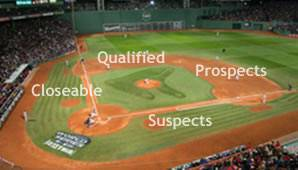
In the baseball diamond above, capabilities, value propositions, and presentations take place between third base and home plate. Yet, when a salesperson gets an audience with a prospect the salesperson is has just reached first base. It's inappropriate to run directly from first base to third base without touching second base on the way! But that's what 84% of all salespeople skip the valuable criteria that sits between first and second base, as well as between second and third base.
A salesperson representing the industry leader or the low-price leader might get the business by being in the right place at the right time, but it's nearly impossible for everyone else to succeed in these scenarios. It is very difficult to sell without uncovering a prospect's compelling reasons to buy (spend money) and buy from you instead of your competitors. That is just one of many criteria that must occur between first and second base. It's nearly impossible to sell without learning how much money the prospect will spend and that is just one of many criteria that must be identified between second base and third base. When a salesperson isn't aware of those two important slices of information, it isn't possible to differentiate (think decommoditize) your company from the pack nor can you present both a needs and cost appropriate solution!
What can you do about this problem?
There are few sales trainers that I have read that get to the point better than Dave Kurlan. He's written two articles on the two biggest mistakes salespeople make.
I'm sharing them with you because I've committed these mistakes myself over the years and I know you have too.
Here is his article about the first mistake.
Thank you!
Ev
"A Heck of A Nice Guy"
Ask 10 people and you'll get 10 different answers about the biggest mistake that salespeople make. Ask the question a bit differently and I will give you a different answer too. But ask the question in the title - "What is the single biggest mistake that salespeople make?", with the key word being mistake - something they do incorrectly rather than due to a weakness - and I can provide data to back it up. There are actually 3 mistakes that are nearly always made but 2 of them happen as a result of the single biggest mistake.
Objective Management Group has conducted nearly 9000 sales force evaluations and more than 550,000 sales assessments. The data clearly shows that in 84% of the cases, salespeople make inappropriately timed presentations. What does that mean?
These days, the typical point of entry for a salesperson is AFTER a prospect determines an interest in purchasing a product or service. They think they know what they want and THEN the salespeople get involved. Prospects ask for a presentation of capabilities, and salespeople present their value proposition. Prospects ask for pricing and salespeople create a proposal. Then the salespeople begin to follow up, but the prospects have already disappeared and mistake #2 occurs - inappropriately timed follow up.
Let's use my Baseline Selling model to illustrate why the presenting taking place in the scenario above is inappropriately timed.

In the baseball diamond above, capabilities, value propositions, and presentations take place between third base and home plate. Yet, when a salesperson gets an audience with a prospect the salesperson is has just reached first base. It's inappropriate to run directly from first base to third base without touching second base on the way! But that's what 84% of all salespeople skip the valuable criteria that sits between first and second base, as well as between second and third base.
A salesperson representing the industry leader or the low-price leader might get the business by being in the right place at the right time, but it's nearly impossible for everyone else to succeed in these scenarios. It is very difficult to sell without uncovering a prospect's compelling reasons to buy (spend money) and buy from you instead of your competitors. That is just one of many criteria that must occur between first and second base. It's nearly impossible to sell without learning how much money the prospect will spend and that is just one of many criteria that must be identified between second base and third base. When a salesperson isn't aware of those two important slices of information, it isn't possible to differentiate (think decommoditize) your company from the pack nor can you present both a needs and cost appropriate solution!
What can you do about this problem?
Saturday, October 9, 2010
Goodbye Mom. I Love You!
My Mom died today.
Here is her obituary.
Make sure you hug your loved ones!
Thank you Mom!
Ev
Kamikawa, Annamae
Annamae died October 8, 2010 at the age of 87 after a courageous battle with Pulmonary Fibrosis.
Annamae cherished her family and is survived by three sons: Paul (Theresa) of Belgium, Dan (Betty) of Toledo, OR, and Everet (Julie) of Milwaukee; six daughters: Chris (Hubert) King of Annandale, VA, Meredith (Saul) Shuster of Fort Lauderdale, FL, Linda (Ken) Nolan of Greenfield, Kathy Kamikawa of Milwaukee, Pat (Bill) Famiglietti of Muskego, Barb (Jeff) Seonbuchner of BrownDeer; and 12 grandchildren: Tyson (Kristine), Keith, Peter, David (Heather), Claire, Samantha, Eric, Michael, Elizabeth, Kimberly, Hanna, Hiroshi; and 3 great grandchildren: Isabelle, Lily, and Isaac.
Annamae graduated from Holy Angels High School and attended Spencerian College in Milwaukee where she met her husband Paul. During World War II, she supervised the building of outboard motors for the Navy at Fairbanks Morse of Beloit, WI. She was a gifted singer who passed that passion to her children. She sung with the Bel Canto Holiday Chorus, Irish Fest mass choir, Old St. Mary's choir, and the St. Philip Neri choir.
She was committed to her parish by serving as its Council President and Boy Scout board member. She was active in her community as an election judge volunteer for 25 years, neighborhood watch committee member and a member of the Parkinson's support group at the Washington Park Senior Center.
Services and visitation will be held Monday October 11, 2010 from 3:00pm-6:30pm with a memorial at 5:30pm. Zwaska Funeral Home, 4900 W. Bradley Road. 414-354-5330 begin_of_the_skype_highlighting 414-354-5330 end_of_the_skype_highlighting. She will be interred at Wisconsin Memorial Park at a future date.
The family requests that donations in lieu of flowers be sent to the Pulmonary Fibrosis Foundation, 811 W. Evergreen Ave., Suite 303, Chicago, IL 60642. http://www.pulomonaryfibrosis.org.
Here is her obituary.
Make sure you hug your loved ones!
Thank you Mom!
Ev
Kamikawa, Annamae
Annamae died October 8, 2010 at the age of 87 after a courageous battle with Pulmonary Fibrosis.
Annamae cherished her family and is survived by three sons: Paul (Theresa) of Belgium, Dan (Betty) of Toledo, OR, and Everet (Julie) of Milwaukee; six daughters: Chris (Hubert) King of Annandale, VA, Meredith (Saul) Shuster of Fort Lauderdale, FL, Linda (Ken) Nolan of Greenfield, Kathy Kamikawa of Milwaukee, Pat (Bill) Famiglietti of Muskego, Barb (Jeff) Seonbuchner of BrownDeer; and 12 grandchildren: Tyson (Kristine), Keith, Peter, David (Heather), Claire, Samantha, Eric, Michael, Elizabeth, Kimberly, Hanna, Hiroshi; and 3 great grandchildren: Isabelle, Lily, and Isaac.
Annamae graduated from Holy Angels High School and attended Spencerian College in Milwaukee where she met her husband Paul. During World War II, she supervised the building of outboard motors for the Navy at Fairbanks Morse of Beloit, WI. She was a gifted singer who passed that passion to her children. She sung with the Bel Canto Holiday Chorus, Irish Fest mass choir, Old St. Mary's choir, and the St. Philip Neri choir.
She was committed to her parish by serving as its Council President and Boy Scout board member. She was active in her community as an election judge volunteer for 25 years, neighborhood watch committee member and a member of the Parkinson's support group at the Washington Park Senior Center.
Services and visitation will be held Monday October 11, 2010 from 3:00pm-6:30pm with a memorial at 5:30pm. Zwaska Funeral Home, 4900 W. Bradley Road. 414-354-5330 begin_of_the_skype_highlighting 414-354-5330 end_of_the_skype_highlighting. She will be interred at Wisconsin Memorial Park at a future date.
The family requests that donations in lieu of flowers be sent to the Pulmonary Fibrosis Foundation, 811 W. Evergreen Ave., Suite 303, Chicago, IL 60642. http://www.pulomonaryfibrosis.org.
Wednesday, October 6, 2010
Why & How Salespeople Can Start a Blog

My brother asked me awhile ago why he would ever want to start a blog.
In his case and career it might not make sense. For anyone looking to establish themselves as an "expert" in a particular area, blogging is now an essential tool to help establish that credibility. It still doesn't carry quite the same weight as writing a book, however blogging has made it easier to get published.
There are several blog sites out there. Probably the most popular are WordPress, TypePad, and Blogger.com. I believe there are links to all three in the apps section on LinkedIn and all can be synced to your profile as mine is.
If you are going to start a blog first decide what it is going to be used for.
Business or Personnel.
Whichever it is, try not to mix personnel stuff in a business blog (unless appropriate) and vice versa, at least on a regular basis. You want to remember who your audience is. They are reading because it is information they are interested in. If you clutter it up with too much other stuff you will lose readers.
Once you know what you are going to write about, schedule some time each week or each day to write something. The key to making a blog is to be consistent. If you decide to post something each day then do that, or every other week or once a week, whatever is right for you.
Once you start writing you don't have to write big stories all the time. Just a paragraph or two will work. Look for articles you can comment on or include in your blog post. Include videos, pictures, graphs, etc.
The more you write and the more places you link your blog to and the more keywords you tag your blog with, the more the search engines will find you and rank you higher up (that is important for a biz blog-personnel stuff not so much potentially).
in the search rankings (see my SEO blog: http://http//everetsblog.blogspot.com/2010/10/why-seo-is-important-to-salespeople.html)
If you want some ideas on what a blog can look like, other than this one,
here are two fun examples:
http://pastrypiratesailsforth.blogspot.com/
http://tonysbeijingreview.blogspot.com/
I hope that helps!
Ev
"A Heck of A Nice Guy"
Monday, October 4, 2010
Why SEO is Important to Salespeople & Managers
Google "Heck of a Nice Guy" or "A Heck of a Nice Guy" and this is what you get:
Google
Advanced search on 9/28/2010
About 615,000 results (0.33 seconds)
Search Results
1. Ev's Sales Answers
When doing a search on my tag line, "A Heck of A Nice Guy," I saw this article by Chip Camden. In his article he talks about IT consultants, however if you ...
everetsblog.blogspot.com/ -
Google
Advanced search on 7/14/2010
About 20,700,000 results (0.45 seconds)
Search Results
1. Ev's Sales Answers - A Heck of a Nice Guy.
Observations about sales force development. Written for Sales Managers, Salespeople, and sales Recruiters with a touch of humor from ...
everetsblog.blogspot.com/ - CachedA Heck of A Nice Guy: Why the title "A Heck of a Nice Guy"
Granted, not too many people might search for the terms above, however I've gone by this title for the last 10 years. It is on my business cards, was the original title for this blog, and often is part of my email signature. You might not remember my name, but you might remember the "heck of a nice guy" tagline. It is my personal brand.
In sales it helps you with your credability if you are known by your clients as an "expert" in something. You want them to think of you first if they ever have a question about whatever it is you are an expert in. There are millions of salespeople. How are you different? Product? Style? Clothes? Whatever it is own it and your prospects and clients will remember you.
In this day and age of the internet a customer can call up thousands of "experts" on any subject they like. If you aren't one of the top listings the odds of you gettling looked at go down. How you get listed toward the top is the subject of another blog. For now just figure out something you can own.
So why did I choose "A Heck of A Nice Guy" to own? Other salespeople are known as great closers, or trainers. I have yet to meet someone that has said they WANT to be known as a jerk or mean guy. If people buy things from people they know & like, or aspire to be like, then people want to buy from someone "nice." When we are on our deathbeds I believe everyone wants to be able to have a list of thier accomplishments, once of them being known as "A Heck of A Nice Guy or Lady."
Advanced search on 9/28/2010
About 615,000 results (0.33 seconds)
Search Results
1. Ev's Sales Answers
When doing a search on my tag line, "A Heck of A Nice Guy," I saw this article by Chip Camden. In his article he talks about IT consultants, however if you ...
everetsblog.blogspot.com/ -
Advanced search on 7/14/2010
About 20,700,000 results (0.45 seconds)
Search Results
1. Ev's Sales Answers - A Heck of a Nice Guy.
Observations about sales force development. Written for Sales Managers, Salespeople, and sales Recruiters with a touch of humor from ...
everetsblog.blogspot.com/ - CachedA Heck of A Nice Guy: Why the title "A Heck of a Nice Guy"
Granted, not too many people might search for the terms above, however I've gone by this title for the last 10 years. It is on my business cards, was the original title for this blog, and often is part of my email signature. You might not remember my name, but you might remember the "heck of a nice guy" tagline. It is my personal brand.
In sales it helps you with your credability if you are known by your clients as an "expert" in something. You want them to think of you first if they ever have a question about whatever it is you are an expert in. There are millions of salespeople. How are you different? Product? Style? Clothes? Whatever it is own it and your prospects and clients will remember you.
In this day and age of the internet a customer can call up thousands of "experts" on any subject they like. If you aren't one of the top listings the odds of you gettling looked at go down. How you get listed toward the top is the subject of another blog. For now just figure out something you can own.
So why did I choose "A Heck of A Nice Guy" to own? Other salespeople are known as great closers, or trainers. I have yet to meet someone that has said they WANT to be known as a jerk or mean guy. If people buy things from people they know & like, or aspire to be like, then people want to buy from someone "nice." When we are on our deathbeds I believe everyone wants to be able to have a list of thier accomplishments, once of them being known as "A Heck of A Nice Guy or Lady."
Wednesday, September 29, 2010
Thanks Dominic!
I'm coaching my four-year-old son's kindergarten soccer team.
We had our first game and practice last night.
It is the first time I have coached any kind of sport.
It is also the first time my son has played a team sport.
I was so proud that he scored the first goal!
What made the the night really great though happened after the game.
As kids and parents were leaving and I was walking back to the car with my son, one of other players, Dominic, passed by with his parents and with an excited face yelled "thanks coach!"
I can't tell about how cool a feeling that is and the spring it has put into my step today!
We talk all the time about having a mentor or coach in your professional life.
It is one thing to be a coach or mentor for another adult, however
if you haven't served in that capacity in some way for a kid I really recommend it.
No matter what Dominic does in his athletic career or I do in my coaching career, I'll always be known as "Coach K" to him.
That is a cool feeling.
Thanks Dominic!
Ev
"A Heck of A Nice Guy"
We had our first game and practice last night.
It is the first time I have coached any kind of sport.
It is also the first time my son has played a team sport.
I was so proud that he scored the first goal!
What made the the night really great though happened after the game.
As kids and parents were leaving and I was walking back to the car with my son, one of other players, Dominic, passed by with his parents and with an excited face yelled "thanks coach!"
I can't tell about how cool a feeling that is and the spring it has put into my step today!
We talk all the time about having a mentor or coach in your professional life.
It is one thing to be a coach or mentor for another adult, however
if you haven't served in that capacity in some way for a kid I really recommend it.
No matter what Dominic does in his athletic career or I do in my coaching career, I'll always be known as "Coach K" to him.
That is a cool feeling.
Thanks Dominic!
Ev
"A Heck of A Nice Guy"
Monday, September 27, 2010
Rod Stewart & Barry Manilow as Salespeople?
Dave Kurlan, author of "Baseline Selling" and founder of Objective Management Group, has written many great articles over the years (including several I've linked to in this blog).
I thought this one was fun:Rod Stewart & Barry Manilow Could Be Your Veteran Salespeoplehttp://bit.ly/9gbDzx
In the article Dave argues that Rod and Barry putting out "safe albums" of covers and standards for older fans. This is the equal to a veteran salesperson who has developed a list and now is sitting back farming the renewals and not going after new accounts or even trying new ideas with the old clients to get more revenue from them.
In addition to the questionable ambition of Rod and Barry, I would also hold the record management accountable. My guess is they know that Barry and Rob fans will purchase anything they record, so it is safe revenue for the record label. This is just like a sales manager who doesn't want to upset a veteran salesperson because they don't want to risk losing that piece of their overall revenue goal by forcing them to change, and having them quit. The revenue generated for the label by Rod and Barry, while it my shrink a bit from album to album, is still a certain amount of revenue they can count on from year to year.
I'd also argue that the record management might have tried to get Rod and Barry to record something different to gain new fans and Barry and Rod might have refused. Instead of dropping them from the label, management wants to keep them around for as long as they can produce some revenue rather than let them go to the competition. This is just like a sales manager who instead of dumping the veteran and giving the developed list to someone that will actually work the accounts to get new revenue, they keep the veteran person on because then the current company gets the revenue and not a competitor.
While huge hot acts like Elvis or The Beatles don't come along everyday so it can be scary to drop an act because you don't know initially how you are going to replace their revenue, there are plenty of acts like U2 or Metallica that have started small but kept doing the basics better and better and now they are huge revenue makers. Sales managers need to get salespeople on their staffs that do the basics and become big rather than keeping the veteran salespeople who have lost the fire and are slowly fading into oblivion. Some of the new and upcoming salespeople may turn out like Metallica and be solid revenue producers for years, others may turn out more like Britney Spears, hot for awhile, then become too much of a burden on the company and need to be dropped. Some of the new salespeople might be like Hanson. They get to the top and the salesperson and company ride the wave, but then they crash and the salesperson is never heard from again. Some acts when given the right management and coaching (like Britney Spears got when her dad took over her management) get another chance and make hit albums again. Other acts like Autograph are one hit wonders and flame out. The secret is to recognize which way the salesperson is going and act accordingly.
I'd argue in either case your company is better off taking a chance on an early U2, an unknown Carrie Underwood, or an up & down Brittney than hanging on to a staff of Barry Manilows and Rod Stewarts.
Ev
"A Heck of A Nice Guy"
I thought this one was fun:Rod Stewart & Barry Manilow Could Be Your Veteran Salespeoplehttp://bit.ly/9gbDzx
In the article Dave argues that Rod and Barry putting out "safe albums" of covers and standards for older fans. This is the equal to a veteran salesperson who has developed a list and now is sitting back farming the renewals and not going after new accounts or even trying new ideas with the old clients to get more revenue from them.
In addition to the questionable ambition of Rod and Barry, I would also hold the record management accountable. My guess is they know that Barry and Rob fans will purchase anything they record, so it is safe revenue for the record label. This is just like a sales manager who doesn't want to upset a veteran salesperson because they don't want to risk losing that piece of their overall revenue goal by forcing them to change, and having them quit. The revenue generated for the label by Rod and Barry, while it my shrink a bit from album to album, is still a certain amount of revenue they can count on from year to year.
I'd also argue that the record management might have tried to get Rod and Barry to record something different to gain new fans and Barry and Rod might have refused. Instead of dropping them from the label, management wants to keep them around for as long as they can produce some revenue rather than let them go to the competition. This is just like a sales manager who instead of dumping the veteran and giving the developed list to someone that will actually work the accounts to get new revenue, they keep the veteran person on because then the current company gets the revenue and not a competitor.
While huge hot acts like Elvis or The Beatles don't come along everyday so it can be scary to drop an act because you don't know initially how you are going to replace their revenue, there are plenty of acts like U2 or Metallica that have started small but kept doing the basics better and better and now they are huge revenue makers. Sales managers need to get salespeople on their staffs that do the basics and become big rather than keeping the veteran salespeople who have lost the fire and are slowly fading into oblivion. Some of the new and upcoming salespeople may turn out like Metallica and be solid revenue producers for years, others may turn out more like Britney Spears, hot for awhile, then become too much of a burden on the company and need to be dropped. Some of the new salespeople might be like Hanson. They get to the top and the salesperson and company ride the wave, but then they crash and the salesperson is never heard from again. Some acts when given the right management and coaching (like Britney Spears got when her dad took over her management) get another chance and make hit albums again. Other acts like Autograph are one hit wonders and flame out. The secret is to recognize which way the salesperson is going and act accordingly.
I'd argue in either case your company is better off taking a chance on an early U2, an unknown Carrie Underwood, or an up & down Brittney than hanging on to a staff of Barry Manilows and Rod Stewarts.
Ev
"A Heck of A Nice Guy"
Thursday, September 23, 2010
What Grades Are You Getting?

This week has been a bit crazed so far.
We're reaching back into the archive for another good reminder from Jeff Gitomer.
Thank you!
Ev
"A Heck of A Nice Guy"
What grades are you
getting in business?
All WOW!s…
Remember when you were in school and you got your report card?
And you were so nervous that you didn’t open it, because you thought there were bad grades, and you just couldn’t look? Or worse, you thought your parents would be angry?
Finally, on the way home from school, you couldn’t stand it so you looked. Or you traded cards with a friend and looked at each others. You got a C in math, you felt you didn’t deserve it, and you hated old Mrs. So-and-So?
You only got six report cards a year. One every six weeks. They were progress reports and grades for that marking period. And you had to wait another six weeks to improve or redeem yourself.
Fast-forward a few years (or 20) to life, job, career, sales, service, co-workers, and customers.
Report cards are now instant, and they come in all forms. Verbal communications from co-workers, comments from your boss both good and bad, customer compliments for a job well done, or botched email, text, IM, or voicemail from anyone. Even a hand-written note.
Report cards are now instant. And they can come at any time. You get them every day from co-workers and from customers, but the grading system is different – they call them word forms, not letter forms.
A failing grade is “What were you thinking?” The next highest is “Let me speak to your supervisor.” The middle grade is “Thanks” or “Good job.” It’s passing, but not great. The second highest grade is “Great job. I really appreciate that.” And the highest grade is, “WOW!”
When someone tells you “WOW!” it means you did something they were not expecting, or you performed or delivered beyond their expectations.
WOW! comes one of two ways: reactively customers call about something wrong and you react and respond all the way to a WOW! Or proactively you uncover a need and fill it before the customer knows it was going to happen. The easiest example is a backorder where you call the customer in advance and give them choices.
But it could be something like a new way to install or use your product, or a new item that just came in that you thought would be perfect for the customer. Or you had an idea that you gave to your company or your customer, and their response was WOW!
When someone tells you “WOW!” it means that you have gone the extra mile. WOW! and extra mile are siblings - equally valued - and one leads to the other. When you go the extra mile, someone will say “WOW!” And when someone says, “WOW!” it means you are going the extra mile.
You helped someone when they weren’t expecting it. You created a service response that went beyond your customer’s expectations. Or you performed a random act of kindness…and got a “WOW!”
Subscribe to:
Posts (Atom)